Kashgar, also known as Kashi in Chinese, is the largest westernmost city in China, located in the Xinjiang region near the border with Afghanistan, Kyrgyzstan, Tajikistan and Pakistan. It’s been a crucial trading center and strategically important city along the Silk Road between China, the Middle East, and Europe for over 2000 years. In addition, Xinjiang is a vital agricultural region that is rich in minerals and oil. As such, it’s had a very tumultuous history, with various dynasties and rulers vying to conquer.
Kashgar was incorporated by the People’s Republic of China in 1949, and since then China has incentivised Han Chinese to relocate to the Xinjiang region. Nonetheless, Muslim Uyghurs are still the predominant population in Xinjiang. You don’t have to dig deep to learn about the turmoil local Uyghurs have endured from China… It’s a very upsetting situation – here are some links for insight:
I flew to Kashgar after visiting Beijing for a few days, as the company I worked for arranged a popular group trip along the Karakoram Highway, which starts in Kashgar. During my travels before landing, I was reading Rebiya Kadeer’s biography. She is an ethnic Uyghur woman who recalls being a child when China incorporated her family’s land. She became a successful businesswoman and well-known activist, which was unusual for a woman. She was imprisoned in China and eventually released to the U.S. due to political pressure. I was reading the book as someone very naive to Kashgar’s situation, wanting to learn a bit before arriving. When my local guide picked me up from the airport and greeted me, he became very visibly uncomfortable simply knowing I had her book in my possession. He said to me, “Do not say her name aloud”. A chill went down my spine, and I immediately felt the real fear local Uyghur’s were living with under Chinese surveillance.
Our first stop was “Old Town”, strolling the lovely and landscaped neighborhood alleyways. The area was clearly renovated not long ago, and felt far from “old”. The actual older residential area was said to be dangerous and not earthquake-safe, so tourists were not allowed. Somewhat seemingly staged, but nonetheless a pleasurable stroll giving a glimpse into the more comfortable side of Kashgar life.


Our stroll lead us to the Id Kah Mosque, the largest mosque in Xinjiang. My guide stayed outside while I explored. Afterward, I probed as to why, and he hesitated to say, but claimed by showing his identification to enter, which was requested from everyone and everywhere, his entry will be recorded and could be used against him as the Chinese government does not condone Islam. The mosque was practically empty, other than a few other tourists who appeared to be Chinese. On the walls were banners of Chinese propaganda. I’m told one sign said something along the lines of – “Unity brings society to success, separatism brings society to disaster.” 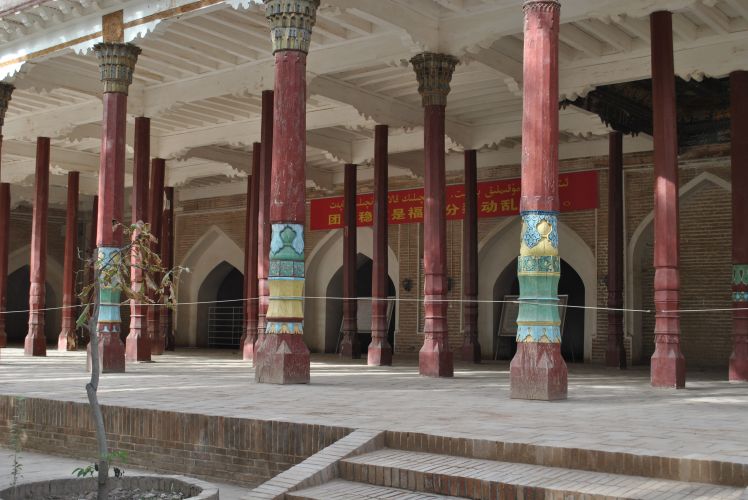
We then visited the Tomb of Afaq Khoja, a beautifully tiled mausoleum, said to contain tombs of five generations and 72 family members.


The Sunday Market is also very important in Kashgar, and said to be the largest market in Central Asia. Thousands of farmers and dealers from surrounding areas come to buy and sell livestock, fruits and vegetables, jewelry, crafts, fabrics, etc. The livestock portion is now separate due to expansion, located in a suburb southeast of the city. It was a sight (and smell) to behold! Action happening in every direction…


Outside of Kashgar is Shipton’s Arch, assumed to be the world’s tallest natural arch. We had plans to visit and hike around, but rain ruined our plan and redirected us to visit Dawakun Desert. While the views of rolling sand dunes were enchanting, the tourist area offered a man-made lake to boat in, dirt roads to ATV, and camels to ride. A family friendly scene, but also a very unauthentic atmosphere.


It was beyond worthwhile visiting Kashgar, getting to learn about the area, history, and current situation. However, unlike anywhere else I’ve ever traveled, I quickly felt ready to leave as I continued to watch the blatant oppression of local Uyghurs. Locals continuously and sadly held back from speaking truth, in complete fear. Numerous security checkpoints are laid out across the city and on outside roads, and it’s mainly the local Uyghurs that are being scrutinized. I went to a laundromat near my hotel to get some clothes washed, and the woman running it was hysterical as soon as we entered. She was crying and speaking in the local dialect, so when we left, I once again questioned (essentially pressured) my guide to explain. Apparently her husband was taken away that morning to “re-education camp” for being accused of using a VPN on his computer. Note, all over China people openly use VPNs, including schools. Also note, when someone is taken to “re-education camp”, there is no telling when they’ll be released, what they’ll be forced to do, or if they’ll even make it out alive. It became infuriating simply being present for such atrocity, but not being able to do anything to help.
Kashgar still embodies slight resemblance of its historic charm, but sadly not much. As a foreign traveler, it is still imperative to see, explore, experience, and share stories. Not only to support the local people and economy, but also to give more exposure to the inhumane acts China is imposing on Uyghurs, with hopes the situation will be forced to improve with pressure from the global community.
 Wandering Ways